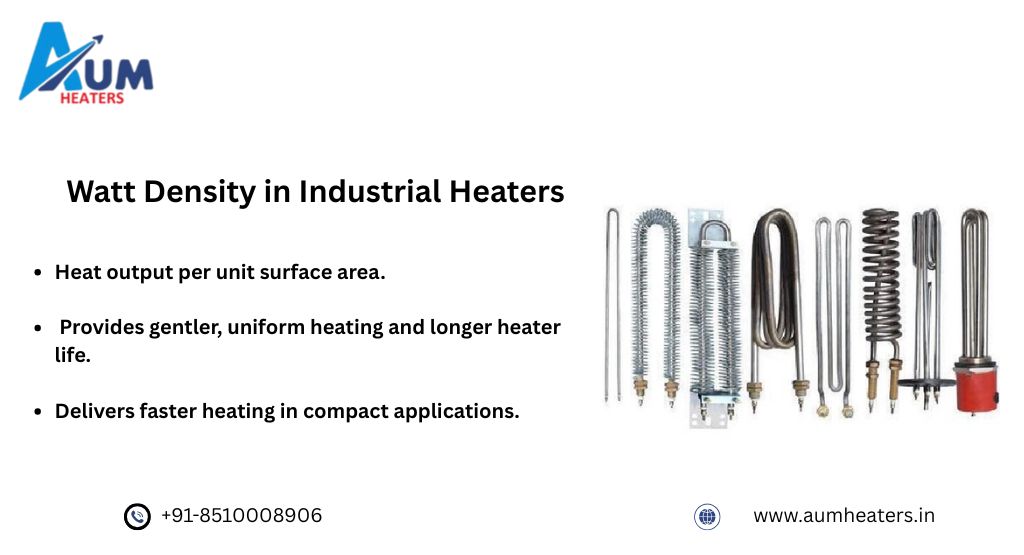
What is Watt Density in Industrial Heaters & Why It Matters
Watt density in heaters is the amount of electrical power delivered through a unit of the heater’s effective heated surface area, commonly expressed in W/in² or W/cm². It matters because the same heater wattage can behave very differently depending on how much surface area carries that power. Correct watt density supports effective heat transfer, stable process temperatures and longer heater service life, while excessive density can increase sheath temperature, accelerate degradation and contribute to premature failure.
What Is Watt Density in a Heater?
In simple terms, watt density describes how concentrated the heating power is on the active surface of a heating element. The basic calculation is:
Watt Density = Heater Wattage ÷ Effective Heated Surface Area
For example, a 2,000 W element with an effective heated surface area of 100 in² has a watt density of 20 W/in². If the same 2,000 W is concentrated over only 50 in², the density becomes 40 W/in². The electrical input is unchanged, but the thermal loading on the heater surface is substantially higher.
Industrial heater manufacturers use watt density as an important design parameter because heat must move from the resistance wire through the insulation and sheath and then into the material being heated. Chromalox defines watt density as the heat flux from each square inch of effective heating area and uses it alongside factors such as sheath temperature and sheath material during heater selection.
Why Does Watt Density Matter for Heater Performance?
Watt density directly influences the temperature that develops at the heater surface for a given application. When the surrounding material can remove heat effectively, a higher watt density may be practical. When heat transfer is poor, the same density can create excessive surface or sheath temperatures.
This is why higher wattage does not automatically mean a better industrial heater. Two heaters may deliver the same total kilowatts but use different heated surface areas. The heater with greater surface area can distribute the heat load more broadly and may maintain a lower surface temperature.
Watlow notes that heater-to-part fit, operating temperature, material being heated and heat-transfer conditions all influence appropriate watt density. Its engineering guidance also explains that increasing flow or turbulence can improve heat transfer and permit higher watt-density operation in suitable liquid or gas applications.
How Watt Density Affects Heater Lifespan
One of the most important relationships is:
Higher thermal loading → higher required surface temperature → greater stress on heater materials.
If watt density is excessive for the application, the heater may struggle to transfer heat quickly enough. This can raise sheath and internal element temperatures, accelerate oxidation or insulation degradation, and increase the risk of premature failure. Excessive surface temperature can also damage the process material, causing problems such as coking, scorching, deposits or discoloration in temperature-sensitive applications.
A lower watt density can often support cooler heater operation and longer life, but it is not automatically the correct choice. If the density is unnecessarily low, the heater may require more surface area, more elements or a larger installation to deliver the required heat load and heating rate. The engineering objective is therefore appropriate watt density, not simply the lowest possible number.
What Causes Industrial Heater Burnout?
Watt density is one potential contributor to heater burnout, but it should not be considered in isolation. Common factors include inadequate heat transfer, poor heater-to-part contact, incorrect sheath material, insufficient liquid level, unsuitable airflow or fluid flow, contamination, scaling, excessive operating temperature and repeated thermal cycling.
For example, a heater designed for efficient immersion heating can experience very different conditions if part of the element becomes exposed to air. Likewise, a cartridge heater installed with poor thermal contact inside a bore may not transfer heat effectively to the surrounding metal. The resulting temperature rise can shorten element life even when the rated wattage appears appropriate.
This is why diagnosing heater burnout reasons should involve the complete thermal system rather than changing only the heater wattage.
Low vs High Watt Density: Which Is Better?
Neither is universally better. The right choice depends on the process.
| Consideration | Lower Watt Density | Higher Watt Density |
|---|---|---|
| Heat concentration | Lower | Higher |
| Typical thermal loading | Gentler | More concentrated |
| Potential heat-up speed | Lower | Higher |
| Surface temperature risk | Generally lower | Generally higher |
| Space requirement | Often greater | Often smaller |
| Suitable use | Sensitive materials, demanding life requirements | Compact designs, strong heat-transfer conditions |
Actual allowable values vary considerably by heater construction and application. For example, commercial heater designs span very different maximum watt densities: Watlow lists 100 W/in² for one high-temperature strip heater, 30 W/in² for a ceramic-fiber heater and 120 W/in² for certain screw-plug immersion configurations. These figures demonstrate why a generic watt-density number should never be applied to every heater type.
How to Choose the Right Watt Density for an Industrial Heater
Start with the heat load, required temperature, heating time and material being heated. Then evaluate how heat will leave the heater surface: conduction through a metal block, convection through moving air or liquid, or another transfer mechanism.
The heater design should also consider sheath material, element construction, available surface area, installation fit, flow conditions, operating temperature and temperature-control strategy. For immersion heaters, fluid characteristics and circulation are particularly important. For cartridge heaters, close thermal contact with the surrounding metal can be critical.
A practical selection process should therefore answer five questions:
-
What material or medium is being heated?
-
What temperature must the process reach?
-
How quickly must it heat?
-
How effectively can heat be transferred away from the element?
-
What heater construction and sheath material suit the environment?
A Practical Example: Why More Watts May Not Solve Slow Heating
Consider a hypothetical industrial tank that needs additional heating. Increasing heater wattage may appear to be the obvious solution. However, if the additional power is concentrated over the same small heated area, watt density also increases. If the fluid cannot remove that heat effectively, the heater surface can become excessively hot while the overall process still fails to achieve uniform heating.
A better engineering solution may involve increasing heated surface area, improving circulation, distributing the load across multiple elements or selecting a different heater configuration. The objective is not simply to maximize electrical input; it is to transfer the required heat reliably and uniformly.
How Can You Optimize Heater Lifespan?
Heater lifespan optimization begins during specification, not after a heater fails. Correct watt density should be combined with suitable materials, proper installation, effective thermal contact or fluid flow, accurate temperature sensing and appropriate power control.
Watlow specifically recommends compatible sheath material and watt-density selection and notes that rapid power switching can reduce heater element temperature excursions and extend heater life.
For buyers and maintenance teams, this can translate into fewer unexpected shutdowns, more predictable maintenance intervals and lower lifecycle costs. The cheapest heater is not necessarily the lowest-cost solution if repeated failures create ion downtime and replacement expenses.
What Should You Ask an Industrial Heater Manufacturer?
Before ordering a custom or replacement heater, provide the manufacturer with the application conditions rather than specifying wattage alone. Useful information includes the required power, voltage, target temperature, heated material, heating time, available dimensions, installation method, operating environment and process-flow conditions.
For Aum Heaters, this application-based approach is particularly relevant because its published company information states that it manufactures ceramic, mica, tubular, cast-in, coil and cartridge heaters and provides technical support for determining appropriate wattages for different applications. Its range also includes tubular immersion, air-finned, cartridge, mica, ceramic, nozzle and cast-in heating solutions.
FAQs About Watt Density in Heaters
What is watt density in heaters?
Watt density is the heater's power output divided by its effective heated surface area, normally expressed in W/in² or W/cm². It indicates how concentrated the heating load is on the active heater surface.
How do you calculate heater watt density?
Use Watt Density = Total Heater Wattage ÷ Effective Heated Surface Area. For accurate engineering selection, the active heated area—not simply the overall physical dimensions—should be used.
Does high watt density cause heater burnout?
It can contribute to premature failure when the heat-transfer conditions, sheath material or operating temperature cannot support the applied thermal load. However, burnout can have multiple causes, so the complete installation should be evaluated.
Does lower watt density make a heater last longer?
Lower watt density can reduce thermal loading and surface temperature in suitable applications, which may support longer life. However, excessively low density can make a heater unnecessarily large or slow, so the correct value depends on the process.
Is wattage or watt density more important?
Both matter, but they answer different questions. Wattage tells you how much total heating power is available; watt density tells you how concentrated that power is over the heated surface. A reliable industrial heater requires both to be considered together.
The Bottom Line
Understanding watt density in heaters helps engineers and buyers move beyond simply asking, “How many kilowatts do I need?” The better question is whether the selected heater can deliver that power at an appropriate thermal loading for the material, temperature, installation and heat-transfer conditions.
For industrial heating applications, Aum Heaters can evaluate the required wattage and heater configuration based on the application rather than treating watt density as an isolated specification. Contact Aum Heaters to discuss your heating load, operating conditions and heater dimensions before selecting or replacing an industrial heating element.
Read more:- Ceramic vs Mica Band Heater


