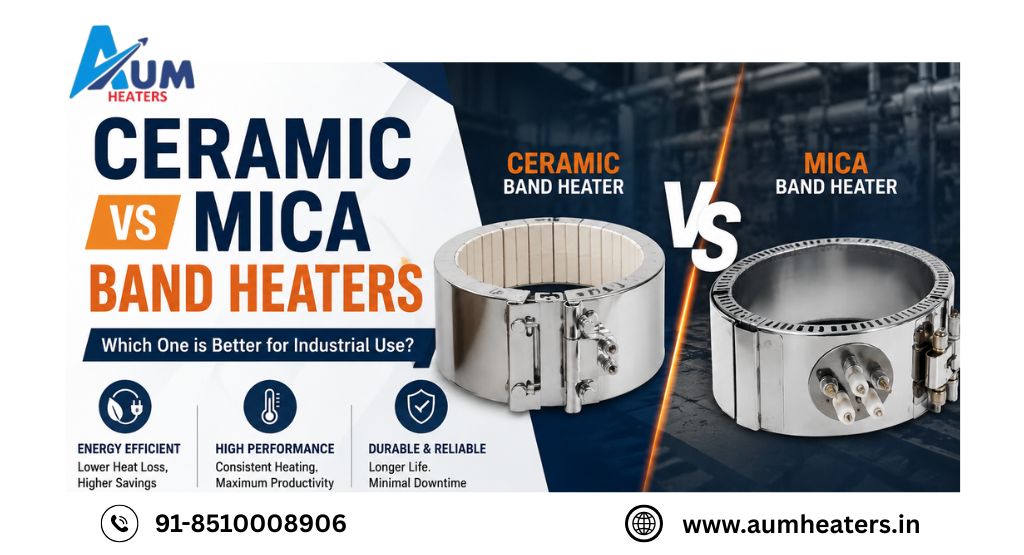
Ceramic vs mica band heater comparisons depend on operating temperature, energy efficiency, heating speed, and application requirements. Ceramic band heaters are better for high-temperature, energy-efficient industrial operations, while mica band heaters offer faster heat transfer and lower initial cost for moderate-temperature applications. The right choice depends on your process, operating conditions, and ion goals.
Band heaters are among the most widely used industrial heating solutions for processing plastics, packaging materials, extrusion systems, injection molding machines, blow molding equipment, drums, and metal components. Yet one question continues to influence purchasing decisions:
Should you choose ceramic or mica band heaters?
Although both perform the same basic function—heating cylindrical surfaces—they differ significantly in construction, operating temperature, insulation performance, energy consumption, lifespan, and maintenance requirements. Selecting the wrong heater can increase power consumption, create uneven heating, shorten machine life, and increase ion downtime.
This guide compares ceramic vs mica band heater technology from a practical industrial perspective. You'll learn how each heater works, where each performs best, their advantages, limitations, operating costs, and which option offers the best value for different manufacturing environments.
Ceramic vs Mica Band Heater: What's the Main Difference?
The biggest difference between ceramic and mica band heaters is insulation and operating temperature. Ceramic band heaters include insulated ceramic blocks that reduce heat loss and improve efficiency at higher temperatures, while mica band heaters use mica insulation for direct heat transfer, making them ideal for medium-temperature applications where fast heating and lower upfront cost are priorities.
Both heaters wrap around barrels or cylindrical equipment, but their internal construction changes how efficiently they transfer and retain heat.
|
Feature |
Ceramic Band Heater |
Mica Band Heater |
|---|---|---|
|
Maximum Operating Temperature |
Up to 700°C |
Around 350–450°C |
|
Energy Efficiency |
Excellent |
Good |
|
Heat Loss |
Low |
Higher |
|
Heating Speed |
Moderate |
Fast |
|
Initial Cost |
Higher |
Lower |
|
Operating Cost |
Lower |
Higher over time |
|
Service Life |
Longer |
Moderate |
|
Maintenance |
Less Frequent |
More Frequent |
|
Best Applications |
High-temperature continuous ion |
Medium-temperature industrial heating |
What Is a Ceramic Band Heater?
A ceramic band heater is an insulated industrial heater that uses ceramic bricks surrounding a nickel-chromium resistance coil. The ceramic insulation minimizes heat loss while maintaining uniform temperatures, making it highly suitable for continuous high-temperature industrial processes.
Instead of transferring all generated heat directly outward, ceramic insulation stores and redirects thermal energy toward the machine barrel. Many designs also include stainless steel insulation jackets that further reduce energy loss.
This construction provides several important advantages:
- Better temperature stability
- Reduced energy consumption
- Longer heater life
- Improved thermal efficiency
- Consistent heating during continuous ion
Ceramic band heaters are commonly used in:
- Plastic extrusion lines
- Injection molding machines
- Blow molding equipment
- Pipe extrusion
- Pharmaceutical machinery
- Food processing equipment
- Rubber processing systems
What Is a Mica Band Heater?
A mica band heater uses mica sheets as electrical insulation between resistance wire and the stainless-steel sheath. It delivers rapid heat transfer through direct conduction, making it suitable for moderate-temperature industrial applications.
Mica has excellent dielectric properties while remaining thin enough to transfer heat efficiently.
Because less insulation exists between the heating element and the barrel, heat reaches the machine faster. However, this also means more heat escapes into the surrounding environment.
Mica heaters are widely used for:
- Packaging machinery
- Food equipment
- Small extruders
- Laboratory equipment
- Die heating
- Plastic processing machines operating below 400°C
Which Heater Is More Energy Efficient?
Among energy efficient band heaters, ceramic band heaters generally outperform mica band heaters because their insulated design significantly reduces heat loss, especially during continuous operation and high-temperature ion cycles.
One of the biggest operating costs in manufacturing is wasted heat.
Ceramic insulation acts like a thermal barrier, directing more energy into the barrel rather than the surrounding air.
In contrast, mica heaters rely more on direct conduction. While this creates faster heating, more energy escapes through radiation.
Heater Heat Loss Comparison
|
Parameter |
Ceramic |
Mica |
|---|---|---|
|
Surface Heat Loss |
Low |
Higher |
|
Thermal Insulation |
Excellent |
Moderate |
|
Energy Savings |
Higher |
Lower |
|
Long Production Runs |
Excellent |
Good |
|
Heat Retention |
Excellent |
Moderate |
In facilities operating multiple extrusion or molding machines around the clock, even a modest improvement in thermal efficiency can significantly reduce annual electricity costs.
Ceramic vs Mica Band Heater Performance at High Temperatures
Ceramic band heaters are designed for sustained high-temperature operation, while mica band heaters perform best at moderate temperatures. For continuous processes above approximately 400°C, ceramic heaters generally provide better reliability and longer service life.
High operating temperatures accelerate insulation degradation.
Ceramic materials withstand repeated heating cycles far better than mica insulation, making them more suitable for demanding industrial environments where machines operate continuously.
Manufacturers running 24/7 ion often prefer ceramic heaters because they:
- Maintain temperature consistency
- Reduce thermal fatigue
- Require fewer replacements
- Improve ion stability
Which Heater Heats Faster?
Mica band heaters usually reach operating temperature faster because their thinner insulation transfers heat directly to the barrel. Ceramic heaters may require a slightly longer warm-up period but retain heat more effectively once operating temperature is reached.
If ion involves frequent machine start-ups and short operating cycles, faster heating can improve efficiency.
However, during continuous operation, ceramic heaters compensate through better heat retention and lower ongoing energy consumption.
Which Band Heater Lasts Longer?
Ceramic band heaters generally have a longer service life due to superior insulation, lower operating stress, and better resistance to thermal cycling. Mica heaters may require replacement sooner in demanding industrial applications.
Factors affecting heater lifespan include:
- Operating temperature
- Machine fit
- Barrel condition
- Voltage stability
- Maintenance practices
- Installation quality
Proper installation and temperature control extend the life of both heater types.
Cost Comparison: Initial Price vs Long-Term Value
Mica band heaters usually have a lower purchase price, while ceramic band heaters often deliver a lower total cost of ownership through reduced energy consumption, longer lifespan, and fewer replacements.
Many purchasing teams focus only on initial cost.
However, industrial heating should be evaluated based on lifecycle cost rather than purchase price alone.
|
Cost Factor |
Ceramic |
Mica |
|---|---|---|
|
Purchase Price |
Higher |
Lower |
|
Electricity Cost |
Lower |
Higher |
|
Replacement Frequency |
Lower |
Higher |
|
Downtime Risk |
Lower |
Moderate |
|
Long-Term ROI |
Excellent |
Good |
For continuous manufacturing, the additional investment in ceramic heaters is often recovered through lower operating expenses over time.
Which Industries Prefer Ceramic or Mica Band Heaters?
Ceramic heaters are preferred for heavy-duty, high-temperature manufacturing, while mica heaters remain popular for medium-temperature industrial equipment where cost and rapid heating are important considerations.
Ceramic Band Heater Applications
- Plastic extrusion
- Blow molding
- Injection molding
- Rubber processing
- Pharmaceutical equipment
- Industrial packaging
- Chemical processing
Mica Band Heater Applications
- Packaging machines
- Food processing equipment
- Laboratory heating
- Light industrial machinery
- Printing equipment
- Small plastic processing systems
How to Choose Between Ceramic and Mica Band Heaters
The right heater depends on operating temperature, ion hours, energy costs, maintenance expectations, machine design, and overall lifecycle cost rather than purchase price alone.
Ask these questions before selecting a heater:
- What operating temperature is required?
- Is the machine running continuously or intermittently?
- How important are energy savings?
- What is the available maintenance schedule?
- How often can heaters be replaced?
- Is temperature uniformity critical?
- What is the expected equipment lifespan?
Facilities operating around the clock typically benefit from ceramic heaters, while intermittent operations often find mica heaters sufficient.
Why Manufacturers Choose Aum Heaters
Choosing the right heater involves more than selecting a from a catalog. Proper sizing, watt density, sheath material, terminal configuration, insulation quality, and machine compatibility all influence performance and service life.
Aum Heaters manufactures, supplies, exports, and provides OEM industrial heating solutions designed to meet diverse process requirements. From standard band heaters to customized heating assemblies, every solution is engineered for reliable performance, efficient heat transfer, and long-term durability.
Customers rely on Aum Heaters for:
- Customized heater manufacturing
- OEM ion capabilities
- High-quality materials
- Precision engineering
- Consistent quality
- Technical consultation
- Timely delivery
- Reliable after-sales support
Key Takeaways
-
Ceramic band heaters are better suited for high-temperature, continuous industrial operations.
-
Mica band heaters offer quicker heating and lower upfront costs for medium-temperature applications.
-
Ceramic heaters generally provide superior energy efficiency and lower heat loss.
-
Lifecycle cost is often more important than initial purchase price.
-
Selecting the right heater depends on process temperature, ion hours, maintenance strategy, and long-term operating costs.
FAQs
Is a ceramic band heater better than a mica band heater?
Not always. Ceramic band heaters are generally the better choice for high-temperature, continuous-duty applications because they offer improved insulation, reduced heat loss, and longer service life. Mica band heaters are often the better option for moderate-temperature processes where fast heating and lower initial investment are the primary considerations.
Which band heater consumes less electricity?
Ceramic band heaters usually consume less electricity over extended ion cycles because their insulated construction reduces heat loss and improves thermal efficiency. Although mica heaters heat up quickly, they typically lose more heat to the surrounding environment during continuous operation.
Can mica band heaters replace ceramic band heaters?
They can replace ceramic heaters only if the application's temperature, operating conditions, and performance requirements fall within the mica heater's capabilities. For high-temperature or continuous industrial processes, ceramic heaters are generally the more reliable solution.
How long do ceramic and mica band heaters last?
Service life depends on operating conditions, installation quality, temperature control, and maintenance. Under similar operating environments, ceramic band heaters generally last longer because their insulation experiences less thermal stress and offers better resistance to repeated heating cycles.
Which industries benefit most from ceramic band heaters?
Plastic processing, extrusion, injection molding, blow molding, pharmaceutical manufacturing, rubber processing, and chemical industries commonly benefit from ceramic band heaters due to their high operating temperatures, energy efficiency, and reliable long-term performance.
Does heater heat loss affect ion costs?
Yes. Greater heat loss means more electricity is required to maintain process temperatures. Selecting energy efficient band heaters with better insulation can reduce operating costs, improve temperature consistency, and lower the total cost of ownership over the life of the equipment.
Conclusion
The choice between a ceramic vs mica band heater ultimately depends on your ion environment, operating temperature, energy priorities, and long-term maintenance strategy. While mica band heaters remain a practical and economical solution for moderate-temperature applications, ceramic band heaters provide superior insulation, lower heat loss, greater energy efficiency, and longer service life for demanding industrial operations. Evaluating total lifecycle cost rather than purchase price alone will help you make the most cost-effective decision for your process.
CTA
Looking for the right band heater for your machinery or ion line? Aum Heaters offers high-quality ceramic and mica band heaters, custom-engineered OEM solutions, and expert technical guidance tailored to your application. Contact us today, request a quote, or discuss your project requirements with our specialists to find the most efficient and reliable heating solution for your business.


