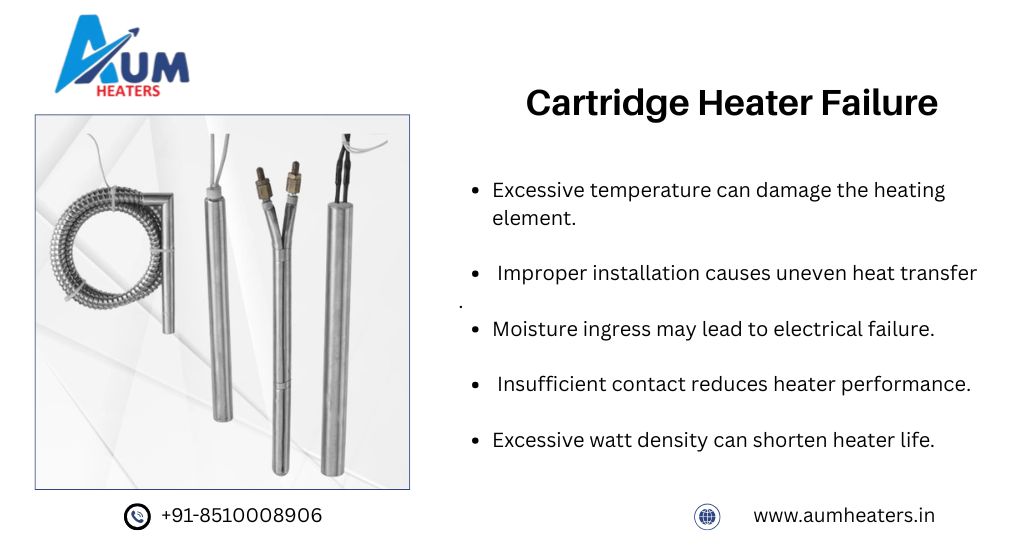
Cartridge heater failure is commonly caused by overheating, poor bore fit, excessive watt density, incorrect voltage, moisture, damaged leads, or temperature-control problems. Identifying the actual failure cause—not simply replacing the heater—helps prevent repeated breakdowns, reduce machine downtime, improve heating consistency, and extend cartridge heater service life in industrial applications.
What Causes Cartridge Heater Failure?
A cartridge heater converts electrical energy into localized heat and transfers that heat through its metal sheath to a surrounding component such as a mold, die, platen, sealing bar, or other heated assembly. Because the heater operates inside a close-fitting bore, its performance depends on more than its voltage and wattage. Installation accuracy, heat transfer, temperature control, operating conditions, and heater construction all affect reliability.
One of the most important cartridge heater failure causes is inadequate heat transfer. If the bore is oversized, rough, contaminated, or poorly machined, an air gap can develop between the heater and the heated component. Air is a poor conductor compared with metal, so the heater can become significantly hotter internally while the surrounding part remains below its desired temperature. Watlow specifically notes that loose hole fit can raise internal heater temperature and contribute to premature failure, particularly at higher watt densities.
1. Poor Bore Fit and Improper Installation
A cartridge heater should fit the application correctly without being forced into the bore. An oversized hole reduces surface contact and heat transfer, while an excessively tight or damaged bore can mechanically stress the heater during installation.
Chromalox recommends drilling and reaming holes for close fit and warns that loose installation can cause the heater to run hotter and fail prematurely. Hammering, twisting, forcing, or using inappropriate conductive lubricants can also damage the heater or shorten its service life.
Before replacing a failed heater, inspect the bore for contamination, carbon deposits, oxidation, burrs, incorrect diameter, and previous installation damage. Otherwise, a new heater may fail for exactly the same reason.
2. Excessive Watt Density and Overheating
Watt density determines how much electrical power is concentrated over the heater's surface area. A heater with excessive watt density for the application can generate a high internal temperature, especially when heat cannot be transferred efficiently into the surrounding material.
High watt density is not automatically a problem; it must be matched to the application, bore fit, heated material, operating temperature, and heat-transfer conditions. Watlow's application guidance shows that both watt density and hole fit influence heater operating temperature.
If a heater repeatedly burns out while the electrical supply appears correct, review the watt density and actual thermal conditions instead of assuming the replacement heater is defective.
3. Incorrect Temperature Sensor Location
A functioning heater can fail because the temperature-control system does not measure the temperature at the right location. If a thermocouple or other sensor is positioned in a cooler area, the controller may continue supplying power while another section of the heated component becomes excessively hot.
Watlow identifies sensor location as an important factor in preventing over-temperature failure and recommends positioning the sensor where it accurately represents the hottest or process-critical region.
Sensor wiring, controller configuration, PID settings, switching devices, and independent over-temperature protection should also be checked during troubleshooting.
4. Incomplete Insertion or Poor Heat Transfer
Cartridge heaters are generally designed to transfer heat through the installed heated section. If part of the active heating length is left exposed when it should be inserted into the application, that exposed section can operate at a much higher temperature.
This is particularly important in applications where the heater is inserted into a metal block or another heat-sinking component. Watlow recommends ensuring the heated section is properly inserted so heat can be transferred away from the heater.
5. Moisture, Contamination, and Insulation Breakdown
Moisture, oil, process contamination, or damaged seals can reduce insulation resistance between the heating element and metal sheath. A heater may still show electrical continuity while developing leakage to ground.
Chromalox advises protecting cartridge-heater leads from spray, oil, and abrasion because contamination can enter unsealed heaters and contribute to insulation breakdown.
If a heater repeatedly trips a ground-fault device, do not simply reset the protection and continue operating. The heater and surrounding wiring should be isolated and inspected according to the manufacturer's testing procedure.
6. Lead-Wire Damage and Mechanical Stress
The lead transition is another common failure point. Repeated bending, vibration, pulling, abrasion, excessive ambient temperature, or unsupported wiring can damage the leads or their connection to the heater.
Chromalox recommends supporting leads where flexing or vibration occurs and protecting them from environmental contamination.
Avoid pulling the heater into position by its wires, sharply bending leads directly at the heater exit, or routing them through areas that exceed their insulation temperature rating.
How to Troubleshoot a Failed Cartridge Heater
A heater troubleshooting guide should begin with the complete heating system rather than the heater alone. A useful diagnostic sequence is:
-
Isolate the heater safely and follow applicable electrical lockout procedures before testing.
-
Inspect the heater and wiring for burns, cracks, dents, loose terminals, contamination, or damaged leads.
-
Measure resistance across the heater terminals and compare the result with the manufacturer's expected value.
-
Check insulation resistance between the energized circuit and metal sheath when appropriate.
-
Verify supply voltage and current under operating conditions.
-
Inspect the bore for fit, contamination, oxidation, and mechanical damage.
-
Check the sensor and controller, including sensor location, wiring, output devices, and over-temperature protection.
-
Review application conditions, including watt density, operating temperature, insertion depth, heat load, and recent process changes.
Resistance alone does not prove that a cartridge heater is healthy. A heater can have electrical continuity while still suffering from insulation leakage, intermittent lead damage, poor heat transfer, or application-related overheating.
Cartridge Heater Failure Prevention: Industrial Heater Repair Tips
Preventive maintenance should focus on the conditions that cause repeated failures. Before installing a replacement cartridge heater, verify the original voltage, wattage, dimensions, heated length, termination, sheath requirements, and application conditions.
The bore should be correctly machined and kept clean so the heater can transfer heat efficiently. Temperature sensors should be positioned appropriately, while controllers and switching devices should be checked periodically. Leads should have suitable mechanical support and adequate protection from heat, vibration, oil, moisture, and abrasion.
For high-watt-density applications, installation quality becomes even more important. Chromalox recommends close attention to hole fit, sensor placement, power control, and lead protection when operating cartridge heaters at high watt densities.
When Should You Replace the Heater Instead of Repairing It?
A cartridge heater with an open heating circuit, damaged sheath, severe insulation failure, or internal connection failure is generally better treated as a replacement item rather than a field-repair component. However, replacement should follow root-cause analysis.
For example, if three heaters fail in the same bore within a short period, simply ordering three more heaters may increase maintenance cost without solving the problem. Check the bore, watt density, sensor location, operating temperature, voltage, and control system first.
This approach turns industrial heater repair tips into a preventive maintenance strategy: identify why the heater failed, correct the application condition, and then select the replacement heater.
Choosing the Right Cartridge Heater for Your Application
The correct cartridge heater should be selected from the actual application rather than from wattage alone. Buyers and engineers should evaluate:
-
Voltage and required wattage
-
Heater diameter, length, and heated length
-
Required watt density
-
Operating and sheath temperature
-
Bore dimensions and fit
-
Sheath material and environmental exposure
-
Lead-wire type, length, and termination
-
Sensor requirements
-
Heating load and heat-transfer conditions
Aum Heaters manufactures cartridge heaters along with other industrial heating s and states that its technical team supports customers in selecting suitable wattages for different applications. Its company profile also describes resistance, high-voltage, series, and mechanical quality checks during manufacturing.
For customized applications, providing the existing heater drawing or dimensions, voltage, wattage, operating temperature, bore details, application type, and failure history can make heater selection and troubleshooting more precise.
Frequently Asked Questions
Why does my cartridge heater keep burning out?
Repeated burnout can result from poor bore fit, excessive watt density, overheating, incorrect voltage, incomplete insertion, inadequate heat transfer, sensor problems, or control-system faults. The repeated failure pattern should be investigated before installing another heater.
How do I know if a cartridge heater is bad?
A resistance test can identify an open or abnormal heating circuit, but continuity alone is not enough. Also inspect insulation resistance, wiring, voltage, current, bore fit, temperature control, and physical condition.
Can an oversized hole cause cartridge heater failure?
Yes. An excessive gap between the heater and bore reduces conductive heat transfer and can increase the heater's internal operating temperature, contributing to premature failure.
What causes cartridge heaters to overheat?
Common contributors include excessive watt density, poor bore contact, incorrect sensor location, incomplete insertion, inadequate heat removal, excessive operating temperature, and control-system problems.
How can cartridge heater life be extended?
Use the correct heater design and watt density, maintain proper bore fit, install the heater without mechanical damage, position sensors correctly, protect lead wires, control operating temperature, and investigate the root cause of every repeated failure.
Prevent Cartridge Heater Failure Before It Stops Production
Cartridge heater reliability depends on the complete heating system—not just the heating element. Correct selection, bore fit, heat transfer, watt density, temperature sensing, electrical control, and installation practices all work together to determine service life.
If your cartridge heater is failing repeatedly, replacing it with the same specification may not solve the problem. Aum Heaters can help evaluate cartridge-heater requirements and select a suitable heating solution based on application conditions, dimensions, wattage, voltage, and heating requirements.
For technical evaluation or a cartridge heater quotation, share your existing heater specifications, application details, or drawing with Aum Heaters so the replacement can be assessed against the actual operating conditions.
Read more:-Band Heater Selection Guide for Injection Molding


